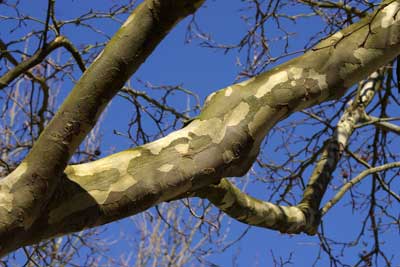
 Pruning is the most common tree maintenance procedure. Although forest trees grow quite well with only nature’s pruning, landscape trees require a higher level of care to maintain their safety and aesthetics. Pruning should be done with an understanding of how the tree responds to each cut. Improper pruning can cause damage that will last for the life of the tree, or worse, shorten the tree’s life. Proper pruning, with an understanding of tree biology, can maintain good tree health and structure while enhancing the aesthetic and economic values of your landscape.
When to Prune Trees
Trees that shed their leaves annually are classified as deciduous trees. Pruning deciduous trees and shrubs at different seasons triggers different responses. In the Charlottesville area, late winter or early spring, before bud break, is a good time to prune many tree species because callus tissue forms rapidly. When pruning flowering trees, take care not to cut off flower buds. Some trees, such as cherry, plum, and crabapple, form buds on old wood. Others, such as crape myrtle, bloom on new wood. [Read more…]
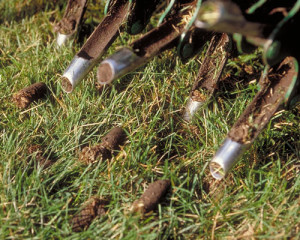
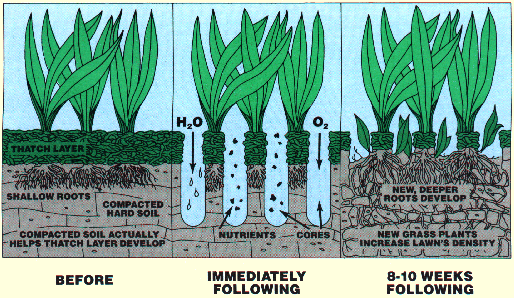 • Aerating holes help to absorb water. Rather than water having to start penetrating from the surface, it can start penetrating from one to 2 ½ inches below the surface. Not only will the holes made by the aerator hold the water, but they will also help the water to sink 2 – 4 inches deeper into the soil.